

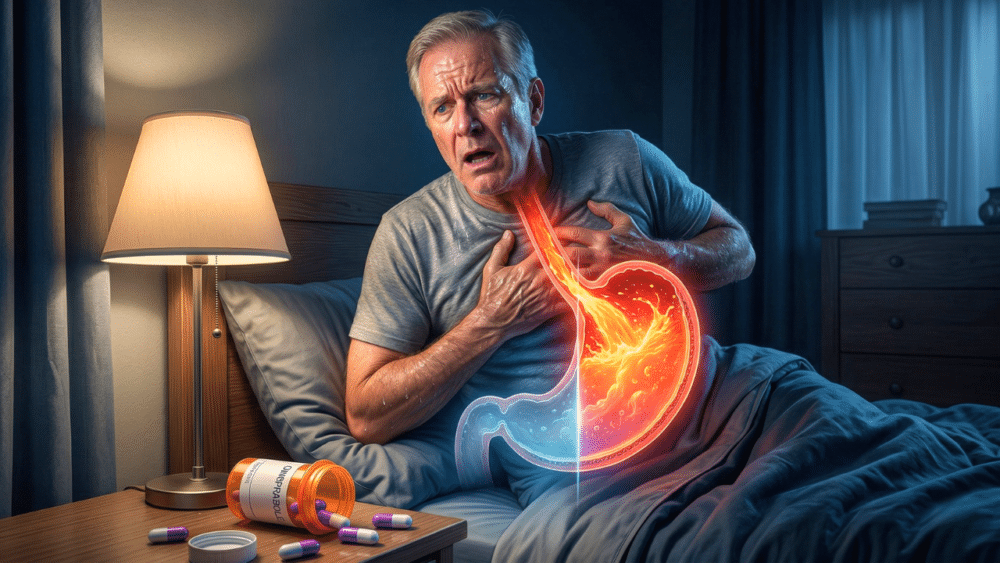
At 3 a.m., 62-year-old Carlos wakes up drenched in sweat with a severe, crushing pain in the center of his chest. The pain is so brutal that his terrified wife calls an ambulance, convinced he’s having a heart attack. In the emergency room, his EKG comes back perfect. His blood work is normal. Carlos’s heart is completely healthy. The problem is coming from his stomach.
It turns out Carlos had been taking omeprazole every day for eight years after it was prescribed for a bout of gastritis. No one ever told him to stop. A few weeks prior, Carlos read online that these pills could destroy his kidneys and cause dementia. In a panic, he grabbed the box of omeprazole, threw it in the trash, and quit cold turkey. What happened to his stomach to make it feel like a heart attack? In this article, we’re going to solve Carlos’s case and answer the most frequent and searched medical questions about omeprazole and related drugs. You’ll learn the myths, the real dangers, how it works in your body, and how to avoid ending up in the ER for stopping it incorrectly. (Based on the insights of Dr. Alberto Sanagustín)
Key Takeaways
- It’s Not a “Protector”: Omeprazole doesn’t coat your stomach. It’s a proton pump inhibitor (PPI) that drastically reduces the production of stomach acid.
- Long-Term Risks Are Real: Chronic use is linked to deficiencies in vitamin B12 and magnesium, an increased risk of bone fractures, and potential kidney issues. These risks develop over years, not weeks.
- Quitting Cold Turkey is Dangerous: Suddenly stopping omeprazole after long-term use can trigger a massive acid rebound, causing severe pain and symptoms that can mimic a heart attack.
- Supervised Tapering is Key: The only safe way to stop taking omeprazole is to do it gradually, following a plan designed by your doctor to allow your body to readjust.
1. Is Omeprazole Really a “Stomach Protector”?
No. Continuing to call it that is a major communication error in medicine. The word “protector” suggests to you, the patient, a physical layer, like a coat of paint that waterproofs the stomach walls so acid can’t burn them. This is false. Omeprazole creates no protective barrier. It works by shutting down the acid-producing machinery in your stomach.
2. How Does Omeprazole Actually Work?
Omeprazole belongs to a family of drugs called proton pump inhibitors (PPIs). Think of your body’s plumbing. Omeprazole doesn’t paint the inside of the pipes; it goes down to the control room and shuts off the main water valve. The “proton pumps” are millions of microscopic faucets in your stomach cells that release acid. Omeprazole’s job is to turn off those faucets, effectively drying up the acid supply. It doesn’t protect; it eliminates the acid from the equation.
3. When Is It Absolutely Necessary to Take Omeprazole?
Its use is strictly justified in very specific situations. First, to heal a gastric or duodenal ulcer, especially if there’s bleeding. Second, to eradicate Helicobacter pylori bacteria, in combination with antibiotics. Third, in cases of severe esophagitis or Barrett’s esophagus, a specific condition affecting the esophageal lining. Fourth, for rare pathologies like Zollinger-Ellison syndrome, where tumors cause the secretion of massive amounts of acid. In these cases, the need is clear.
4. Should You Take Omeprazole “Just in Case” with Ibuprofen?
As a general rule, no. Routinely prescribing it alongside occasional ibuprofen use is excessive and not supported by evidence. Preventive use is justified only if you take anti-inflammatory drugs continuously and have real risk factors, such as being over 65, having a history of ulcers or gastrointestinal bleeding, or simultaneously taking corticosteroids or anticoagulants. If you’re an adult without these risk factors, you don’t need to “protect” yourself for taking an occasional ibuprofen.
5. Are Omeprazole, Pantoprazole, and Esomeprazole the Same?
Their core mechanism is the same: turning off the acid valve. Esomeprazole is a more refined molecular version of omeprazole, achieving the same effect with a slightly lower milligram dose, but the clinical result is nearly identical. The real difference lies in how your liver processes them. Drugs like pantoprazole or rabeprazole are often preferred for patients who are poly-medicated (taking more than five drugs daily) because they interfere less with other medications, which is particularly important for certain heart medications.
6. Do I Have to Take Omeprazole for Life for Reflux?
Not by default. Acid reflux is typically a mechanical problem. The sphincter, the muscle separating your esophagus from your stomach, doesn’t close properly. Omeprazole removes the acidity so the liquid that comes up doesn’t burn, but it doesn’t fix a broken valve. For many patients, addressing the root cause—like losing abdominal weight, eating dinner earlier, or elevating the head of the bed—can allow for the gradual withdrawal of the medication. If the damage requires you to stay on it, the medical rule is to always use the lowest effective dose.
7. Why Does Omeprazole Work Less Effectively with Food?
Omeprazole doesn’t act upon arrival in the stomach. Its mechanism requires it to reach the intestine, get absorbed into the bloodstream, and then travel to the stomach cells to act on the acid pumps. This journey takes time. Taking it with food can make it less effective. It’s like trying to shut off the main water valve when water is already blasting out of all the pipes. The ideal way to take it is 30 to 60 minutes before breakfast. This allows the drug to get into position and be ready to act when your stomach tries to fire up acid production in response to food.
8. Morning or Night: When Is the Best Time to Take Omeprazole?
The medical consensus is to take the standard dose in the morning on an empty stomach. This is because the proton pumps are rested after the overnight fast, making the blockade more effective at this time. However, if your symptoms are exclusively at night, your doctor might instruct you to take it before dinner. Taking it right before you get into bed is generally not useful.
9. Can You Open or Chew Omeprazole Capsules?
It depends on how the capsule is manufactured. This is important for those who have difficulty swallowing. Most capsules contain tiny mini-granules, each with its own enteric coating to protect it from stomach acid. In this case, you can open the capsule and mix the granules with yogurt or orange juice and swallow them whole, without chewing or crushing. Chewing destroys that protective coating, allowing stomach acid to degrade the drug before it can be absorbed in the intestine.
10. Does Omeprazole Work for a Sudden Heartburn Attack?
No, and this is a common mistake. If Carlos had taken an omeprazole during his 3 a.m. chest pain attack, he would have felt no relief. Omeprazole does not neutralize the acid already in your stomach; it prevents new acid from being made. Furthermore, it takes two to three days of continuous doses to reach its maximum effect. For an acute attack of acidity, a rescue antacid is what you need, not omeprazole.
11. What Are the Real Long-Term Risks of Omeprazole?
This is where things get serious. Long-term, unsupervised use carries several documented risks:
- Vitamin B12 Deficiency: Vitamin B12 in food is bound to proteins. Your stomach needs acid to break this bond and free the vitamin for absorption. If you suppress acid for years, B12 can pass through your system unabsorbed, leading to a slow, silent depletion of your body’s reserves. This can result in anemia and neurological problems.
- Magnesium Deficiency (Hypomagnesemia): The exact mechanism isn’t fully understood, but prolonged use of PPIs can impair magnesium absorption. This usually appears after more than a year of continuous use. Symptoms can include muscle cramps, fatigue, weakness, and in severe cases, heart arrhythmias.
- Increased Fracture Risk: Observational studies show an association between long-term PPI use and a higher risk of fractures, especially of the hip, wrist, and spine. The theory is that reduced acid may impair calcium absorption, but the science isn’t settled. If you’re on long-term omeprazole and have risk factors for osteoporosis, this is a conversation to have with your doctor.
- Kidney Disease: This was the headline that terrified Carlos. An association between PPIs and a higher risk of chronic kidney disease does exist in large studies. This isn’t a poison that destroys your kidneys in months, but a modest additional risk with prolonged, high-dose use. The solution is simple: if you need it long-term, your doctor should monitor your kidney function with an annual blood test.
12. Does Omeprazole Interact with Other Common Medications?
Yes, and it’s crucial to be aware of these interactions. For example, omeprazole can reduce the effectiveness of the antiplatelet drug clopidogrel (Plavix) by interfering with its activation in the liver. With thyroid medication (levothyroxine), omeprazole can reduce its absorption by lowering stomach acidity. If you take multiple medications, especially for heart conditions, your doctor needs to know you’re on omeprazole to manage these potential interactions, sometimes by choosing a different PPI like pantoprazole.
13. Can Omeprazole Cause Dementia or Alzheimer’s?
This is another major fear that drove Carlos to trash his pills. While some early observational studies found an association, association does not equal causation. People who take omeprazole long-term are often older and have other health conditions that are themselves risk factors for cognitive decline. More rigorous follow-up studies have not confirmed a direct causal link. The practical advice is not to abandon your medication out of this fear, but to be vigilant about your vitamin B12 levels, as a chronic deficiency does cause real and preventable cognitive decline.
14. Why Does Your Stomach Burn When You Suddenly Stop Omeprazole?
This is the rebound effect, and it’s what happened to Carlos. When you block acid production for months or years, your body senses the lack of acidity and responds by building up extra, reserve proton pumps. If you suddenly stop the medication, it’s like blowing the floodgates off a dam. All those new pumps switch on at once, and a brutal avalanche of acid floods your stomach. It wasn’t the omeprazole destroying Carlos; it was his body’s violent reaction to having it taken away.
15. How Long Does the Rebound Effect Last?
If you stop omeprazole cold turkey after prolonged use, the acid rebound typically worsens over the first few days and often peaks within the first week. Your body will gradually readjust, but for people who have been on it for a long time, it can take several weeks for things to normalize. Knowing this can be reassuring, as it prevents you from interpreting these bad days as proof that you need the drug forever. Often, you’re just experiencing the physiological rebound.
16. What Is the Medical Protocol for Stopping Omeprazole?
There is no single universal protocol; it must be personalized. The fundamental principle is to taper off gradually, not stop abruptly. A common approach is to first reduce the dose, then space out the doses (e.g., to every other day), and perhaps switch to an on-demand schedule. Your doctor will create this plan with you. It’s not about dynamiting the dam; it’s about opening the gates slowly to let the system readjust without causing a flood of acid.
17. Are There Natural Alternatives to Omeprazole?
Once you’ve successfully reduced or stopped the medication, there are options for mild or occasional symptoms. Alginates, derived from seaweed, form a floating raft in the stomach that can help with mechanical reflux. Lifestyle adjustments like eating dinner at least three hours before bed, elevating the head of your bed, and managing your weight can often be more effective than supplements. However, these options are for mild symptoms only and should never replace omeprazole if your doctor has prescribed it for a serious condition like a bleeding ulcer or Barrett’s esophagus.
Conclusion
Let’s return to Carlos. What simulated a heart attack at 3 a.m. was a massive acid rebound. After eight years with the acid valve shut off, he threw away his pills. The dam broke. The acid burned his esophagus with such violence that it triggered an esophageal spasm, a condition with pain indistinguishable from a heart attack. His doctor put him back on omeprazole to calm the crisis and then designed a six-week progressive withdrawal schedule. Today, Carlos is off omeprazole, his kidneys are fine, and his stomach is functioning on its own.
If you take away just one idea from this article, let it be this: Omeprazole is a brilliant medical tool, not a poison, but it demands respect and periodic review. Taking it for life without supervision has real risks, but stopping it cold turkey because of an internet headline carries risks that are just as real. Be informed, be safe, and always work with your doctor.
Source: Dr. Alberto Sanagustín