


Did you know that people with weak legs, on average, die younger than people with strong legs? This isn’t a scare tactic; it’s what research consistently tells us. As an emergency medicine doctor, I see the real-world consequences of this every single day. When an older individual comes into the emergency department after a fall, the story is rarely about the fall itself. It’s about the decades of quiet, gradual muscle loss that made the fall almost inevitable. This article is about the muscle wrapped around your thigh bone, the strength that lets you stand up from a chair without using your arms, and the vital tissue that most people are losing every year without even realizing it. This isn’t just a story about exercise; it’s a story about what happens when you don’t, and how one simple movement can profoundly change your future.
This movement, the humble squat, is so absurdly underrated as a health intervention that it’s almost criminal. By the end of this article, you’ll understand why maintaining the strength in your legs is one of the most powerful things you can do for your health, impacting not just your physical strength but your metabolism, your brain, your balance, and your independence for decades to come. (Based on the insights of Dr. Alex Wibberley)
Key Takeaways
- Leg strength is a powerful predictor of longevity and healthspan. Research consistently shows a direct link between strong legs and a longer, healthier life.
- Age-related muscle loss (sarcopenia) is a serious but preventable condition. It begins in your 30s and accelerates after 40, but you have the power to reverse its course.
- Squats are a highly effective, equipment-free exercise. They build foundational strength, improve your metabolism, and even protect your brain health.
- Consistency is far more important than intensity. Starting small and showing up every day is the key to long-term success.
- You can begin today with a simple chair exercise, regardless of your current fitness level or age.
1. The Silent Thief: Understanding Age-Related Muscle Loss (Sarcopenia)
Your muscle mass peaks somewhere around your mid-20s or early 30s. After that, if you’re not actively doing something to maintain it, you lose roughly 1% to 2% of your muscle mass every single year. That might not sound like much, but let’s do the math. Over 20 years, that’s a loss of 20% to 40% of your muscle. Run those numbers forward 30 years, and you’re in genuinely serious territory. The rate isn’t even linear; it accelerates after the age of 40. The clinical term for this is sarcopenia, and it’s one of the most underappreciated conditions in modern medicine.
Sarcopenia is the difference between moving confidently through the world and needing help to get up from a low chair. Its consequences aren’t abstract. They are falls, fractures, hospitalizations, a loss of independence, and, yes, premature death. I’ve seen the endpoint of this process. An elderly person comes to the emergency department after a fall. The problem isn’t just the fall; it’s the years of muscle loss combined with low bone density and a nervous system that can no longer react fast enough to correct a moment of instability. That stumble becomes a hip fracture, which carries a shocking one-year mortality rate of 30%. People aren’t making decisions about exercise in their 40s and 50s with this information in mind, and that’s a huge part of the problem.
2. More Than Just Muscle: Your Brain’s Lifeline
Here’s the part most people miss: muscle isn’t just passive tissue. It’s a communication system between your body and your brain. Every time you contract a muscle, a signal travels from your brain, down your spinal cord, and out to the individual muscle fibers. Simultaneously, sensory neurons are sending information back to your brain about your joint position, tension, and movement. It’s a constant, two-way, real-time conversation.
Your brain doesn’t just control your muscles; it depends on them to stay calibrated. The cerebellum, the part of your brain that handles coordination and balance, is constantly receiving signals from your legs and feet, telling it where you are in space. When you stop moving regularly, those signals degrade. The neural pathways that support movement become less efficient because your nervous system operates on a brutally simple principle: use it or lose it. The less you move, the worse your brain gets at coordinating movement. This is why, when you start exercising again after a long break, the first changes you notice aren’t physical. In the first couple of weeks of doing squats, your muscle fibers haven’t changed much. What has changed is your nervous system’s ability to recruit those fibers. Your brain is getting better at firing the right muscles at the right time. This is real, tangible progress, even if you can’t see it in the mirror yet.
3. Your Legs: The Metabolic Engine You’re Ignoring
Beyond strength and balance, there’s a powerful metabolic reason to focus on your legs. Your muscles, particularly the large muscle groups in your legs and glutes, are the primary place your body sends glucose (blood sugar) after you eat a meal containing carbohydrates. Think of your leg muscles as a massive storage tank for sugar. When you have plenty of healthy, active muscle, that glucose has somewhere to go and be used for energy.
However, if you lose significant muscle mass over the years, that entire system starts to break down. Your body becomes less efficient at clearing sugar from your blood. Your cells become resistant to insulin, the hormone that helps shuttle glucose into them. Quietly, over years, the conditions for type 2 diabetes begin to develop. Building and maintaining the muscle in your legs is one of the most effective ways to improve your insulin sensitivity and protect yourself from metabolic disease. It’s not just about looking good; it’s about keeping your internal machinery running efficiently.
4. Why the Squat Is the Ultimate Health Intervention
So, why the squat specifically? The honest answer is that the squat is the most complete, functional movement a human can do with absolutely no equipment. When you perform a squat, you engage your quadriceps (front of the thighs), your glutes (your bottom), your hamstrings (back of the thighs), your calves, your hip flexors, and a whole network of core muscles all at the same time. There are very few exercises that give you that much bang for your buck with zero setup.
If you stand up and try one right now, you’ll feel it. You’ll feel all those muscles working in concert to lower and raise your body. This single movement builds the foundational strength you need for everyday life—getting out of a car, picking something up off the floor, or climbing a flight of stairs. It directly translates to a more capable and resilient body.
5. Master the Move: How to Squat Safely and Effectively
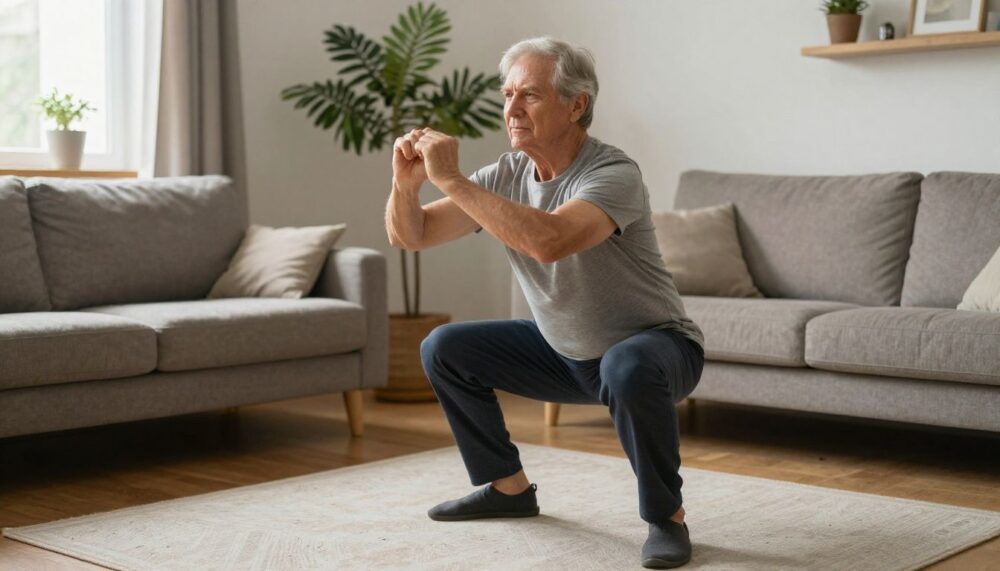
Many people worry that squats are bad for their knees. The truth is, when done properly, squats are protective for your knees. It’s poor technique, repeated over time, that can cause problems. Here’s how to do it right:
- Stance: Stand with your feet slightly wider than shoulder-width apart. Turn your toes out slightly, somewhere between 30 and 45 degrees. Find what feels natural for your hip anatomy.
- Knee Tracking: This is the most important rule. As you squat down, your knees must track in the same direction as your toes. Do not let them collapse inward. Imagine you’re pushing your knees out as you descend.
- Weight Distribution: Keep your weight in your heels, not your toes. Roughly two-thirds of your weight should be going through your heels. A good cue is to think about being able to wiggle your toes at the bottom of the squat. This engages your glutes and hamstrings and protects the front of your knee.
- Back Posture: Keep your back in a neutral position. A slight forward lean is normal and necessary, but avoid rounding your lower back. Keep your chest lifted and proud throughout the movement.
- Depth: Go only as low as feels comfortable and safe for you. If that’s only a partial squat, that’s perfectly fine. That is your starting point.
6. Your Simple Starting Plan: No Gym Required
If you’ve never squatted before or are returning to exercise after a long time off, here is exactly where you should start. Take a sturdy chair and place it behind you. Now, simply practice standing up from it and sitting back down 10 times. The key is to do this without using your arms to push yourself up. If you need a little help from your hands at first, that’s okay. Gradually reduce that assistance over time. That’s it. That’s a squat.
As a minimum, aim for 10 of these chair squats a day. Over time, your goal is to push yourself a little. Every couple of weeks, try to increase something. Maybe you increase the number of repetitions to 15 or 20. Maybe you do two sets of 10 throughout the day. Or maybe you focus on going a little lower each time. This principle is called progressive overload, and it’s the key to getting stronger. Don’t overthink it. Just start where you are and gradually do a little more.
Conclusion: Build Your Future Self, Starting Today
There is a version of aging that I see play out constantly in the emergency department—a version defined by frailty, multiple medications, and a body that has lost its reserves to bounce back from stress. Running through almost all of those cases is muscle loss that started in middle age and was never addressed. The cultural story that tells us to expect decline, to slow down, and to take it easy is fundamentally wrong. Getting weaker is not inevitable.
The trajectory of your health is changeable. The intervention doesn’t require a gym, money, or a huge time commitment. It just requires understanding that your legs are not a minor part of your health. They are the foundation of your independence, your metabolism, and how long you will live well. That foundation needs maintaining long before you see the cracks appearing. Start with squats. Do them today. Do them tomorrow. Do them on the days you don’t feel like it. Your future self—the one who is still climbing stairs, carrying their own shopping, and getting up off the floor without help at 75—is being built by what you choose to do right now.
Source: Dr. Alex Wibberley