
Have you ever wondered if you’re walking ‘correctly’ for your health? Maybe you push yourself to walk faster, thinking that a heart-pounding pace is the only way to see real benefits. Well, I’m here to tell you that new data on walking changes everything. It’s not just about how many steps you take, but it reveals a surprising truth about how fast you should be walking—or rather, how little speed actually matters compared to something else.
We’ve all been told to get our steps in, but recent research has dug deeper, revealing that the sheer volume of your steps is far more powerful for your longevity than the intensity. In this article, we’re going to unpack this groundbreaking science. We’ll explore why your muscles become a powerful ‘glucose sink’ with every step, how walking literally signals your arteries to repair themselves, and how you can trigger your body to build more energy-producing mitochondria. More importantly, I’ll show you how to stack simple, everyday habits—like sipping your morning coffee or tea—with your walk to amplify your results for fat loss, blood sugar control, and overall health. Get ready to rethink everything you thought you knew about your daily walk. (Based on the insights of Thomas Delauer)
Key Takeaways
- Volume Over Velocity: A large-scale study found that your total daily step count has a much stronger impact on reducing mortality risk than your walking speed.
- The Magic Number: Aiming for 8,000 steps per day can cut your mortality risk by about 51% compared to taking 4,000 steps. Increasing to 12,000 steps drops it by 65%.
- Post-Meal Power: A short 5-10 minute walk after eating is one of the most effective habits you can build to blunt blood sugar spikes and improve insulin sensitivity.
- Cellular Mechanisms at Play: Walking works by turning muscles into a ‘glucose sink,’ creating beneficial ‘shear stress’ to repair arteries, and stimulating mitochondrial biogenesis to build more cellular energy.
- Amplify with Caffeine: Combining your walk with coffee or green tea can enhance fat oxidation, improve glucose clearance, and make it easier to walk longer, boosting your overall step count.
1. The Landmark Study: Why More Steps Matter More Than Speed
Let’s jump right into the data that’s shaking up the fitness world. A major study published in the Journal of the American Medical Association (JAMA) analyzed data from 4,840 people over the age of 40. These participants wore accelerometers to track not just how many steps they took, but also the intensity and speed of their walking. Researchers followed them for up to 12 years, and the results were astonishing.
They discovered a clear “dose-response” relationship with step count. Using 4,000 steps a day as the baseline, they found that hitting 8,000 steps per day was associated with a 51% lower risk of all-cause mortality. Pushing it to 12,000 steps a day resulted in a 65% lower risk. This trend was consistent across all ages, genders, and races. The message is clear: more steps equal a longer, healthier life.
But here’s the kicker: what about speed? Initially, it seemed like faster walkers had an edge. However, when the scientists adjusted the data to account for the total number of steps, the advantage of walking faster almost completely vanished. It turns out that people who take more steps throughout the day naturally tend to walk a bit faster, but it’s the volume that does the heavy lifting for your health.
This is fantastic news because it means the single most impactful thing a sedentary person can do is simply to move more, without stressing about heart rate zones or speed. Your primary goal should be to go from 4,000 to 8,000 steps. You can do this by adding small, two-minute walk breaks every hour or by tacking a short walk onto daily triggers like phone calls or coffee breaks.
2. Mechanism #1: Turning Your Muscles into a ‘Glucose Sink’
Now that you know what to do, let’s understand why it works. The first mechanism directly impacts your blood sugar and insulin sensitivity every single day. When you walk, even at a light pace, you turn your muscles into what I call a ‘glucose sink.’ A study in the journal Diabetes Care illustrated this perfectly. Researchers took overweight individuals and had them either sit uninterruptedly or get up for two-minute walking breaks every 20 minutes. Even the light-intensity walking group showed a significantly lower post-meal glucose and insulin response compared to the group that just sat.
The reason is a powerful cellular process. Each step you take activates a pathway called AMPK. This activation signals your muscle cells to move glucose transporters, known as GLUT4, to the cell surface. These transporters then pull glucose directly out of your bloodstream and into the muscle for energy—all without needing insulin. You’re essentially opening up a side door for glucose to exit your blood, reducing the burden on your pancreas. The implications for your long-term health are massive. Less glucose floating around means less damage to your blood vessels, which allows your arteries to repair themselves. Over time, this leads to better insulin sensitivity, less visceral fat accumulation, and a lower risk of metabolic diseases. This is why one of the highest-leverage habits you can build is a simple 5-to-10-minute walk after your meals. It can almost entirely blunt the glucose spike from your food.
3. Mechanism #2: ‘Shear Stress’ and Repairing Your Arteries
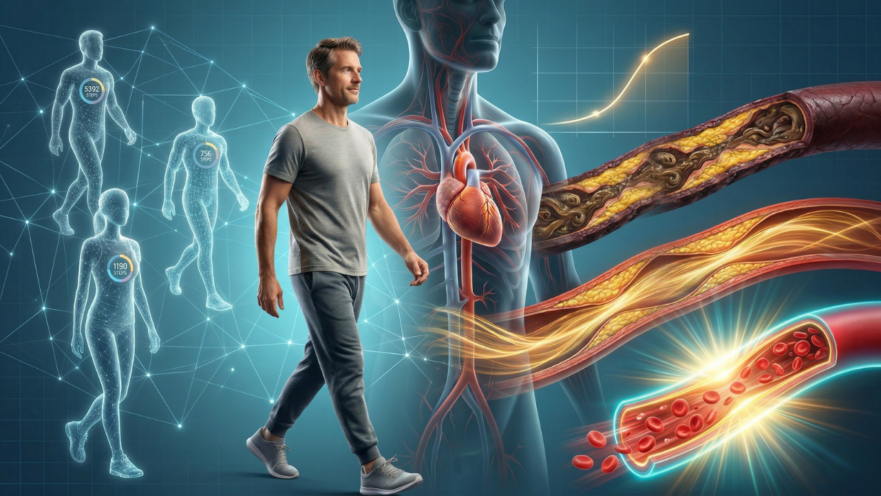
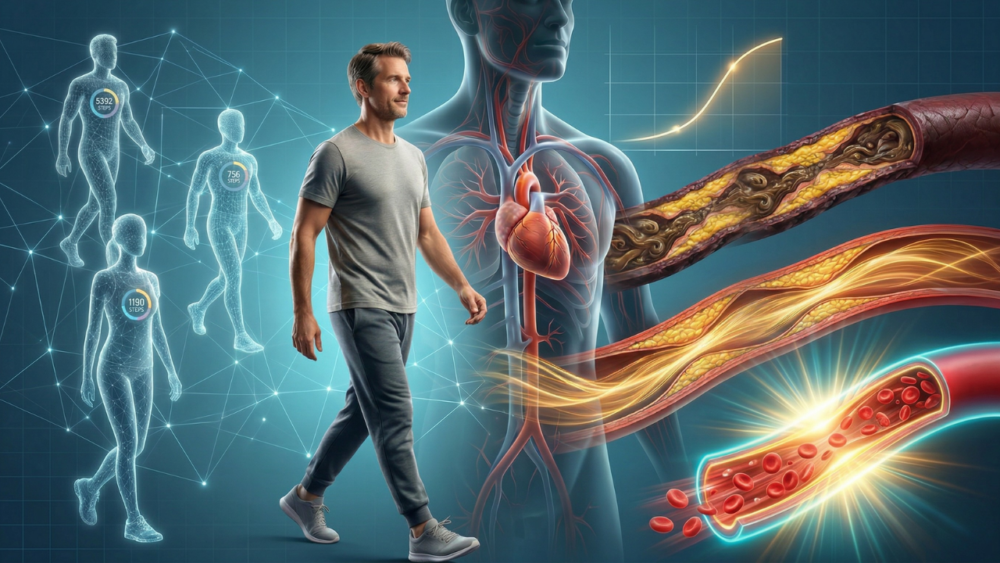
The second mechanism sounds a bit harsh, but ‘shear stress’ is actually a process you want to encourage. Every time you walk, your heart pumps more blood to your working muscles. This repeated pulse of blood flow rushes along the inner walls of your arteries, creating a gentle, frictional force known as shear stress. This stress is a signal that activates an enzyme called endothelial nitric oxide synthase (eNOS).
As its name suggests, eNOS boosts your body’s production of nitric oxide. Nitric oxide is a miracle molecule for your cardiovascular system. It tells your blood vessels to relax and expand, which lowers blood pressure. It also acts as an anti-thrombotic agent, making your blood less sticky and preventing dangerous clots. This directly protects you against atherosclerosis, or the hardening of the arteries. This connects back perfectly to why volume is more important than intensity. What matters for your endothelial health is the cumulative shear stress you generate throughout the day, not one short, intense burst. A higher total step count, spread out over many hours, creates far more of this artery-repairing signal than a single, short, brisk walk. Consistent, daily walking makes your arteries more flexible, improves the stability of any existing plaque, and suppresses the inflammation that drives cardiovascular disease. Once again, volume wins.
4. Mechanism #3: Building Better Cellular Engines with Mitochondrial Biogenesis
If your cells are the factories of your body, then your mitochondria are the engines that power them. As we age, these engines can become dysfunctional, a hallmark of nearly every chronic disease. Walking is one of the most potent ways to maintain and even upgrade these cellular engines. A review in the journal Geroscience laid out exactly how this works.
Walking activates a master regulator in your body called PGC-1α. Think of PGC-1α as the foreman of your cellular factory, and its job is to order the construction of new mitochondria—a process called mitochondrial biogenesis. This means you not only increase the number of your mitochondria but also improve their efficiency at producing energy and reduce the amount of damaging oxidative stress they leak. Furthermore, walking helps restore other key proteins like SIRT1 and SIRT3, which act as a quality control team. They promote the recycling of old, damaged mitochondria (autophagy) and enhance the enzymes that your mitochondria use to create energy. This is directly tied to mortality because having dysfunctional mitochondria is a common thread in obesity, metabolic syndrome, cardiovascular disease, and neurodegeneration. Low-intensity, high-frequency walking is the perfect stimulus to keep these cellular engines running cleanly and efficiently for years to come.
5. Amplify Your Walk: The Surprising Synergy of Coffee and Tea
You might already be doing this next tip without even realizing its power. Having a cup of coffee or high-quality green tea before your walk can dramatically amplify its benefits. A study in BMC Public Health found that among people who sat for more than eight hours a day, those who regularly consumed caffeine (especially from antioxidant-rich sources like tea) had a 33% lower risk of all-cause mortality and a staggering 54% lower risk of cardiovascular mortality.
The magic lies in a two-pronged attack. First, the polyphenols—powerful antioxidants found in coffee and tea—reduce the chronic inflammation and oxidative stress that damage your endothelium. This provides internal protection for your arteries, which stacks perfectly with the external benefits of shear stress from walking. Second, the caffeine itself independently increases fat oxidation, boosts your metabolism, and enhances glucose uptake in your muscles. This means when you walk after drinking coffee or tea, your muscles become an even more powerful glucose sink than they would be from walking alone. Caffeine also reduces your perceived exertion, which means you can walk longer and take more steps without feeling as tired. To maximize this effect, try to have your coffee or tea 30 to 90 minutes before your walk, which is when caffeine levels peak in your bloodstream.
6. Next-Level Bio-Hacks: Three Supplements to Enhance Your Results
If you want to take things even further, you can amplify these exact pathways with a few strategic supplements. The first is carnosine, a dipeptide your body naturally produces. A clinical trial found that supplementing with carnosine significantly improved insulin sensitivity in overweight individuals. It works by scavenging damaging compounds that interfere with insulin signaling in your muscles, essentially clearing the road so your GLUT4 transporters can do their job more effectively.
Second is TMG (trimethylglycine), also known as betaine. TMG is a methyl donor that supports crucial methylation pathways that keep your endothelium healthy and helps process an inflammatory compound called homocysteine. In this way, it complements the shear stress benefits of walking by protecting your arterial walls from the inside out. Finally, here’s a counterintuitive trick: consuming a small amount of fast-acting carbohydrates during a longer walk. It sounds backward, but when you provide glucose to working muscles, you are training them to take it up and use it under insulin-independent conditions. You’re exercising the GLUT4 machinery without involving insulin. Over time, this makes your muscles much better at clearing blood sugar on their own. We’re talking a very small amount, like 15 grams from a sip of honey, during an extended walk. This can actually make you better at handling carbs the rest of the day.
Conclusion
The science is in, and the message is liberating: you don’t need to punish yourself with high-intensity workouts to radically improve your health and extend your life. The key is consistency and volume. Focus on increasing your daily step count, with 8,000 steps as your first major target to cut your mortality risk in half. Remember that every step contributes to better blood sugar control, healthier arteries, and more robust cellular energy. By simply moving more, walking after meals, and perhaps timing your daily coffee with your walk, you are making profound, science-backed changes to your biology. Start small, stay consistent, and let the power of the step carry you toward a longer, healthier future.
Source: Thomas Delauer