
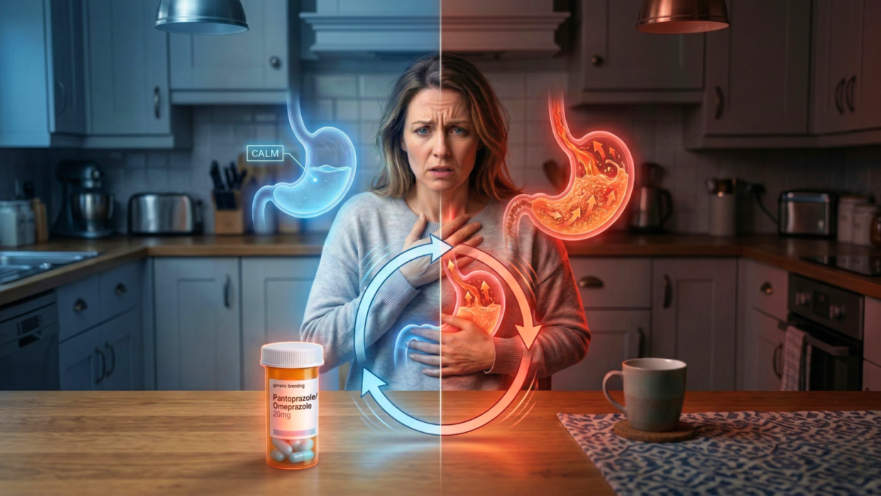
Are you one of the millions of people who feel trapped by your acid reflux medication? You want to stop taking your pantoprazole or omeprazole, but every time you try, the heartburn, stomach pain, and discomfort come roaring back, sometimes worse than ever. It’s a frustrating cycle that can make you feel like you’ll be dependent on these pills for life. But what if I told you there’s a reason this happens, and more importantly, a safe and effective way to break free? This isn’t about a lack of willpower; it’s about understanding your body’s reaction and using a smart strategy to outwit it.
Proton pump inhibitors, or PPIs, are incredibly effective at reducing stomach acid, providing relief for conditions like GERD and ulcers. However, your body is an amazing machine of adaptation. It gets used to the low-acid environment created by the medication. When you suddenly take that medication away, your body panics and overcorrects, producing a flood of stomach acid. This is called the “rebound effect,” and it’s the primary reason why quitting PPIs is so difficult. In this article, we’ll walk you through a step-by-step guide to successfully and permanently weaning yourself off these powerful drugs, so you can take back control of your health. (Based on the insights of pharmacist Maren Torkler)
Key Takeaways
- Consult Your Doctor: Before you make any changes to your medication, always have a conversation with your prescribing physician to ensure it’s the right and safe decision for you.
- Avoid Quitting Abruptly: Stopping PPIs “cold turkey” is the main cause of severe rebound symptoms. A gradual approach is essential.
- Understand the Rebound Effect: Know that a temporary increase in acid and symptoms is a normal physiological response. Expecting it can help you manage it.
- Tapering is the Key: The only proven way to get off long-term PPIs is to taper, or “wean,” your dose down slowly over weeks or even months.
- Patience is a Virtue: The longer you’ve been on a PPI, the longer the tapering process will likely take. Be patient with your body as it readjusts.
1. Why You Feel “Stuck” on Your PPI: Understanding the Rebound Effect
To win this battle, you first need to understand your opponent. The rebound effect, officially known as rebound acid hypersecretion, is a very real and physiological phenomenon. Think of it this way: your stomach contains tiny pumps, called proton pumps, that secrete acid to help you digest food. PPI medications work by blocking these pumps. When you take a PPI every day for months or years, your body notices the lack of acid. In response, it produces more of a hormone called gastrin, which tells the stomach, “Hey, we need more acid! Make more pumps!” Your body essentially builds more acid-producing factories to compensate for the drug’s effect.
Now, imagine you suddenly stop taking the medication. The block is gone. All those extra pumps that your body built are now fully active and ready to go. The result is a massive surge of stomach acid, far more than your body would normally produce. This is why your symptoms come back with a vengeance about one to two days after your last dose. It’s not a sign that your original condition has worsened; it’s a temporary, albeit very uncomfortable, overreaction from your body. Knowing this is the first step to not getting discouraged and reaching for the pill again.
2. The Golden Rule: Never Stop Cold Turkey
Given the power of the rebound effect, the single most important rule is to never stop your PPI abruptly. Many people feel good, decide they don’t need the medication anymore, and just stop taking it. Within 24 to 48 hours (the approximate time the drug stays active in your system), the familiar burning in the chest and sour taste in the mouth return. This leads them to believe they can’t function without the drug, creating a cycle of dependence.
Stopping cold turkey is like trying to slam the brakes on a complex biological process. Your body needs time to adapt. It needs to slowly decommission all those extra acid pumps it built. If you just cut off the supply of the drug, you leave your stomach lining vulnerable to that acid flood. This can not only be painful but can also potentially irritate the esophagus and stomach. The only way to avoid this shock to your system is through a slow, methodical, and patient process of tapering.
3. Step 1: Talk to Your Doctor (This is Non-Negotiable)
Before you even think about reducing your dose, you must have a conversation with your doctor. This is a critical step for safety and success. Your doctor originally prescribed the PPI for a specific medical reason, and they need to agree that it’s appropriate for you to stop. In many cases, especially if the initial issue has resolved, your doctor will be supportive of you weaning off.
Furthermore, you will need your doctor’s help to do it correctly. As we’ll discuss next, tapering often requires getting prescriptions for lower doses of the medication. Most PPI tablets and capsules are designed with a special “enteric coating.” This coating protects the drug from being destroyed by stomach acid so it can be absorbed properly in your intestine. You should never split, crush, or open these pills (with a few specific exceptions like some forms of esomeprazole, but you must confirm with your pharmacist). Doing so destroys the coating and makes the medication ineffective. Therefore, to halve your dose from 40mg to 20mg, for example, you need your doctor to prescribe the 20mg pills.
4. Step 2: The Art of Tapering – Halving Your Dose
Once you have your doctor’s approval and the right prescriptions, you can begin the tapering process. The most common starting point is to cut your current dose in half. For instance, if you are taking 40mg of pantoprazole daily, you would switch to 20mg daily.
The crucial part here is finding the right pace for your body. There is no one-size-fits-all schedule. A good starting point might be to stay on the halved dose for two to four weeks. This gives your body a significant amount of time to begin adjusting to the lower level of acid suppression. Some people might feel fine halving the dose every week, while others who are more sensitive or have been on the drug for many years may need to hold each new, lower dose for a full month or even longer. Listen to your body. If you reduce the dose and feel fine, you can stick to the schedule. If symptoms flare up, it’s a sign you’re moving too fast.
5. Step 3: Managing the Lowest Dose – The “Skip-a-Day” Method
Eventually, you will taper down to the lowest available dose of your medication (e.g., 20mg for pantoprazole or omeprazole). So, what’s next? You can’t halve the dose anymore. This is where you transition from reducing the strength to reducing the frequency. You start skipping days.
A gentle way to begin this phase is to take your pill every other day. Do this for one to two weeks. If your body tolerates this well, you can try to stretch it further. Move to taking the pill once every three days. Again, hold this for one to two weeks to see how you feel. The goal is to gradually increase the number of days between doses, giving your body’s acid-producing cells more and more time to normalize their function. You can continue this pattern—taking it every fourth day, fifth day, and so on—until you are taking the pill so infrequently that stopping it altogether causes no noticeable rebound.
6. What to Do When Symptoms Return During Tapering
It is very common to hit a bump in the road. You might be doing great, and then after a dose reduction, you start feeling that familiar burn again. Do not panic, and do not give up! This is not a sign of failure. It’s simply feedback from your body that you’ve tapered a little too quickly. The solution is simple: go back one step. If you started feeling symptoms after switching from every-other-day to every-third-day, go back to taking the pill every other day. Hold that dose for another two weeks or even longer. Give your body the extra time it’s asking for to stabilize before you try to reduce the frequency again. This process is a marathon, not a sprint. Being patient and responsive to your body’s signals is the most important factor for success.
7. How Long Does It Take? Setting Realistic Expectations
If you’ve been taking a PPI for a decade, you cannot expect to be off it in a month. The longer your body has been adapted to the medication, the more profound the changes in your stomach’s physiology and the longer the re-adaptation process will take. For many long-term users, a successful tapering schedule can last for several months. I know this can sound daunting, but it’s better to go slow and succeed than to go fast and fail, forcing you to start all over again.
Don’t get euphoric and rush the process when you start feeling good. It’s tempting to speed things up, but this often leads to a rebound flare-up that sets you back. Give your body the gift of time. Remember, you are allowing complex systems of hormones and receptors to completely remodel themselves back to their natural state. This biological process cannot be rushed. A slow, steady, and patient approach is your guaranteed ticket to getting off the medication for good.
Conclusion
Getting off a long-term proton pump inhibitor is absolutely achievable, but it requires strategy, knowledge, and above all, patience. You are not addicted to the medication, but your body has become accustomed to it. By understanding the rebound effect and committing to a slow, gradual tapering process in partnership with your doctor, you can successfully wean yourself off and allow your body to find its natural balance again. It may take a few months, but the freedom from being tied to a daily pill is well worth the effort. You can do this. Take it one step at a time, listen to your body, and you will get there.
Source: Pharmacist Maren Torkler