

Since canola oil mimics healthy properties of other oils, including omega-3 fats (as found in fish & flax), and monounsaturated fats (as found in olive oil), proponents feel as though they had made a dream-come-true product.
Canola oil eventually began to appear in the recipes of health books such as those by Andrew Weil and Barry Sears.
The popularity of the Mediterranean diet and olive oil at the time was spreading and many were beginning to substitute their olive oil for canola oil.
It was rumored that most major publishers would not accept cookbooks unless they included canola in the recipes.
Canola Oil is HIGHLY REFINED
But here’s the main problem with canola oil, and why you should think twice before using it – canola oil is highly refined.
Like high fructose corn syrup that is not “corn sugar” once it is extracted and processed, canola oil also has to go through a similar regimen. The oil is removed by a combination of high temperature mechanical pressing and solvent extraction. Traces of the solvent (usually hexane) remain in the oil, even after considerable refining.
Canola oil goes through the process of caustic refining, bleaching and degumming – all of which involve high temperatures or chemicals of questionable safety. And because itis high in omega-3 and 6 fatty acids, (11% and 21% respectively) which easily become rancid and foul-smelling when subjected to oxygen and high temperatures, it must be deodorized. The standard deodorization process removes a large portion of the omega-3 fatty acids by turning them into trans fatty acids.
The Canadian government lists the trans content of canola at a minimal 0.2 percent, but it is speculated that they are actually much higher due to the processing. This processing is much different from that of olive oil, which most often is first cold pressed to reduce the oxidation of the oil. Harmful chemicals and fatty acid-altering processing means do not occur with olive oil as they do with canola oil.
Canola Is a GMO Crop
Another major problem with canola oil is that 80% of the acres sown are genetically modified canola, and it’s not the GMO type of product that has been developed for the benefit of the species of plant, but for the benefit of the herbicide.
First introduced to Canada in 1995, genetically modified canola has become a point of controversy and contentious legal battles as Monsanto’s “Roundup Ready” herbicide allows farmers to drench both their crops and crop land with the herbicide so as to be able to kill nearby weeds (and any other green thing the herbicide touches) without killing their crop.
The effects of this herbicide on the environment as well as the health of individuals who consume the products have been questioned. Superweeds have begun to develop, and much like the overuse of antibiotics, eventually a resistance to the chemical builds up, and a more powerful one must be used. Monsanto is already working on a stronger herbicide (called SmartStax) which they hope to debut soon.
So Should You be Using Canola Oil?
I say, definitely not. Doing so is risky because you’re consuming a product which is highly refined during the processing to obtain the end result (even more so than agave syrup because oils are so much more sensitive than sugars). It’s loaded with herbicides (unless you buy one that is organic), and possibly hydrogenated fats (definitely refined fats).
Either way, remember that all oils high in polyunsaturated fats (those are the omega 3 & 6 fats) are very sensitive to light and heat, and therefore can’t be heated too much, even though it is what most people do with them – cooking.
The reason canola oil’s smoke point is so high (over 400 degrees F) is because it is so refined. You can’t heat a healthy unrefined oil/fat very high without denaturing it.
There is no reason to have canola oil in your house. Unfortunately you’re probably going to get more than you should be consuming just by eating at restaurants, boxed goods (even “healthy” organic varieties) and shopping at places like Whole Foods, who sadly support the canola oil movement.
Obtain your healthy monounsaturated fats from organic extra virgin olive oil and use organic butter and coconut oil for stir/pan frying. Too many omega 6 fats, in the form of corn, soy, safflower, canola oil, and others result in excess inflammation in your body, not a reduction of. So reduce or eliminate those oils high in polyunsaturated fats – the blue bars in the graph below.
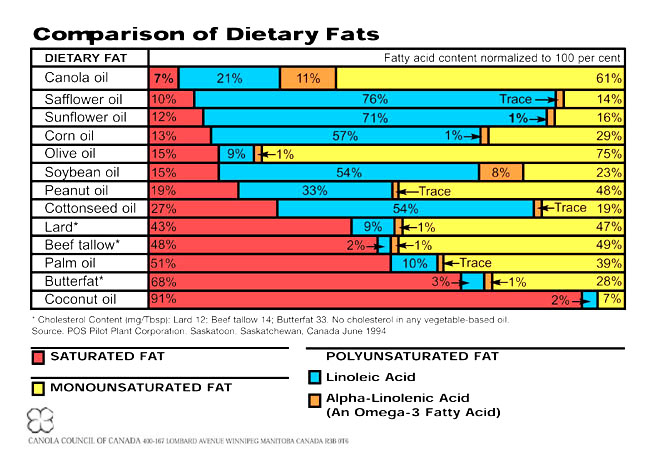
- Use organic butter and coconut oil, not margarine
- Use honey, not agave
- Use organic extra virgin olive oil, and unrefined sesame seed oil
source: Dr Gangemi