
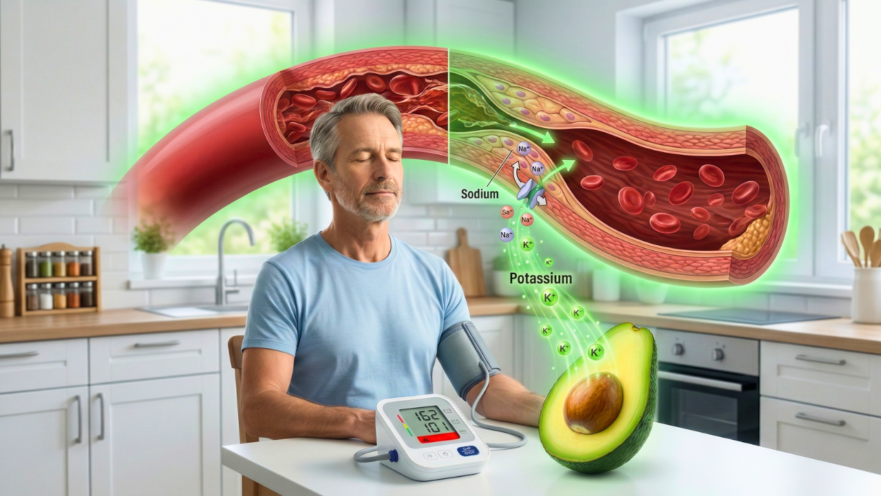
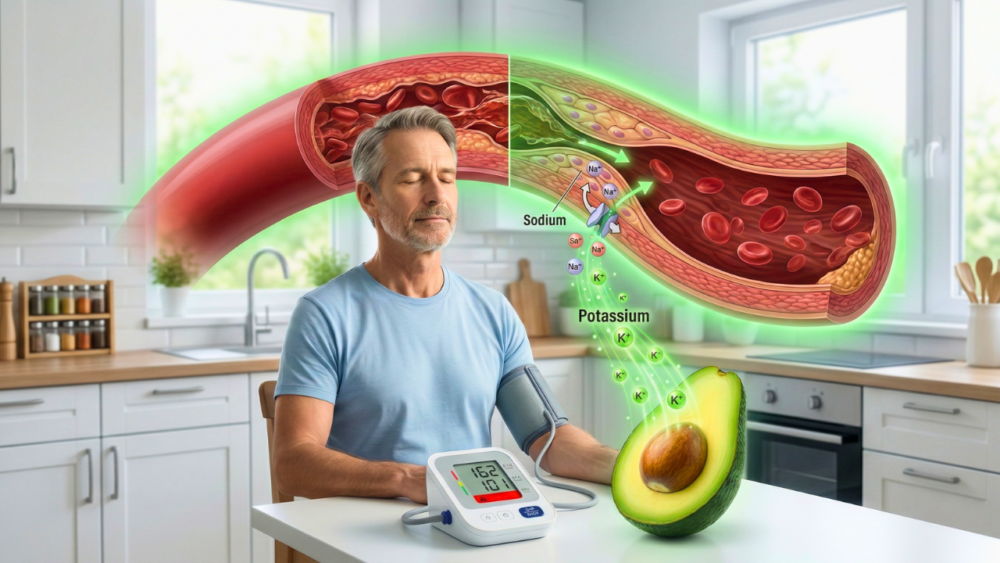
You do everything right. You sit down, take a deep breath, and relax. You feel calm. But when you look at the blood pressure monitor, the numbers are still stubbornly high—145, maybe 150. You ask yourself, “What’s going on? I’m not stressed anymore!” And that’s exactly the point. If you’ve managed your anxiety but your pressure remains elevated, it means the problem isn’t just about your nerves anymore. The problem is your plumbing.
If your blood pressure stays high even when you’re calm, it’s a strong sign that you might be dealing with arterial stiffness. Think of your arteries as flexible hoses. Over time, they can become like old, brittle garden hoses that have lost their ability to stretch and expand. This rigidity is a physical issue that deep breathing alone can’t fix. You need to address it over the medium term with consistent habits and by supporting your body’s natural biochemistry. That’s why, in this article, we’re going to explore three exact ingredients you’re likely missing. These act as physiological “softeners” to help restore that crucial elasticity to your arteries. (Based on the insights of Dr. Alberto Sanagustín)
Key Takeaways
- It’s Not Just About Salt: Simply cutting out salt is only half the battle. The balance between sodium and potassium is what truly matters for fluid regulation and blood pressure.
- Your Arteries Are Alive: Your arteries are lined with muscle that needs to relax. A lack of key minerals, like magnesium, can cause them to stay in a state of constant tension, narrowing the passage for blood.
- Your Body Makes Its Own ‘Opener’: Your body can produce a gas called nitric oxide that actively dilates your blood vessels. Certain foods can dramatically boost its production.
- Food is a Tool: Specific foods aren’t just for nutrition; they are powerful tools that can send chemical signals to your body to relax blood vessels, expel excess sodium, and lower pressure from the inside out.
1. Potassium: The Ingredient That Shows Salt the Door
Here lies the biggest mistake 90% of people make when trying to fix high blood pressure. Everyone tells you to ditch the salt, that salt is poison. And it’s true that excess sodium is bad for you and that you should limit it, especially if you have hypertension. That’s a given. But removing salt is only half the story.
Your body has a natural, built-in pump called the sodium-potassium pump. Imagine it as a revolving door in every one of your cells. For sodium—the mineral that makes you retain water and effectively “inflates the hose”—to get kicked out of the cell, potassium needs to come in. It’s a mandatory exchange. If potassium doesn’t enter, sodium doesn’t leave. The modern problem isn’t just that we eat too much salt (which we do), but that we eat incredibly little potassium. The result? The revolving door gets stuck. Sodium remains trapped inside your cells, your body holds onto water, your blood vessels swell, and your blood pressure skyrockets.
So, the million-dollar question isn’t just “How much salt should I cut?” but also “Where is the potassium I need to get this door unstuck?” When I say potassium, I need you to erase one image from your mind. Your brain probably just screamed “Banana!” Well, marketing has misled us a bit. A banana is fine, and it does contain potassium, but it’s the junior league version. It also comes with a fair bit of sugar and only provides about 350 mg of potassium. To clean out adult-sized arteries, you need the heavyweights. For example, you would need to eat almost three bananas to equal the potassium punch of a single avocado. The avocado is the undisputed king, packing nearly 1,000 mg of potassium per fruit.
Don’t like avocados? No problem. Plan B is dark leafy greens like spinach, chard, and arugula. You can picture them as sponges that absorb and help expel sodium. This brings us to the first “Plumber’s Rule”: Never eat white carbohydrates like rice, pasta, or bread without pairing them with something dark green or half an avocado. Why? When you eat refined flours alone, your body releases a rapid spike of insulin. What most people don’t know is that insulin gives a direct order to your kidneys: “Hold on to salt! Don’t let it go!” Insulin literally slams the exit door on sodium. But if you add something green to the plate, you achieve two things. First, the fiber slows down that insulin spike, so the kidney doesn’t get such a forceful command to retain salt. Second, the potassium from the greens actively helps push the sodium out, getting that revolving door spinning again. You’re forcing sodium out, preventing fluid retention, and taking pressure off the hose from within.
A vital warning: If you have been diagnosed with kidney failure, please ignore this advice and consult your doctor. In this condition, potassium can build up to dangerous levels. However, if your kidneys are functioning properly, this strategy is a game-changer.
2. Magnesium: The Mineral That Unclenches Your Arteries
To understand this next point, I want you to make a fist. Squeeze it tight. Most people think their arteries are like rigid plastic pipes in a wall. This is a huge misconception. Your arteries are living, dynamic tissues lined with a layer of smooth muscle that contracts and relaxes thousands of times a day. The problem is that without the right fuel, this muscular layer can enter what I call a “silent cramp.” It exists in a state of permanent tension, just like that clenched fist. And when the pipe narrows, the pressure naturally shoots up.
So, who is in charge of opening that fist? The answer is magnesium. Magnesium acts as a natural modulator of calcium. In plumber’s terms, it’s the mineral that gives the chemical command for the arterial wall to rest. It tells the muscle, “Let go. Relax.” As it does, the artery dilates and opens up. This is why magnesium is often called nature’s calcium channel blocker.
Where can you find this natural relaxant? Here are three lifesavers packed with magnesium:
- Pumpkin Seeds: These are perhaps the most concentrated and easy-to-consume source. A handful in the mid-afternoon is preventative medicine. It’s a daily habit worth adopting.
- Almonds: This is the perfect heart-healthy snack. It provides both magnesium and healthy fats.
- Dark Chocolate (85% or higher): High-quality cocoa is a potent vasodilator. But be careful—it must be very low in sugar to provide the benefit without the downside.
Remember basic physics: if magnesium relaxes the muscle and the pipe widens, a larger diameter leads to lower pressure. It’s a mathematical certainty. By ensuring you have enough magnesium, you are helping your arteries relax and widen, allowing blood to flow through with less resistance.
3. Nitric Oxide: The ‘Surprise Gas’ That Opens the Floodgates
Our final ingredient isn’t a solid or a liquid; it’s a gas. Your body manufactures a magical gas called nitric oxide, and its function is absolutely vital. It actively dilates the walls of your arteries, transforming them from a narrow country lane into a wide-open highway. What’s fascinating is that this is the same physiological principle that many emergency blood pressure medications aim to replicate. We’re just going to stimulate it naturally and gently, right from the kitchen.
The undisputed champion for boosting nitric oxide is the beet. This is where the science is truly surprising. Studies show that consuming natural nitrates from foods like beets can lower systolic blood pressure by several points in a matter of hours, not weeks. The mechanical effect of dilation is that fast.
Now, don’t panic. You don’t need to drink liters of beet juice or set up a lab to make extracts. While studies often use concentrates, real-life application is much simpler. Just grate one raw beet into your salad or roast it in the oven. With that simple action, you are sending the chemical signal for your arteries to open up.
What if you hate beets? No worries, there’s a Plan B: arugula. This peppery green is a nitrate bomb. A good handful in your dinner salad does the same job. In plumber’s terms, eating these foods generates the gas, the pipe actively expands, and the pressure stops hammering against the walls. Your entire cardiovascular system stops fighting against itself.
Your Simple, Actionable Plan
I don’t want you to get overwhelmed with a complex diet. Instead, just focus on applying these three “Plumber’s Rules” this week. Take a screenshot so you don’t forget.
- The Companion Rule (Potassium): Never eat “white” carbs (bread, rice, pasta) without adding a side of dark greens or half an avocado. This neutralizes the sodium impact of every meal.
- The Anti-Tension Snack (Magnesium): When you get hungry in the afternoon, forget the crackers and cookies. Have a handful of pumpkin seeds or almonds. You’ll be relaxing your arterial walls while you snack.
- The Dilator Dinner (Nitrates): Add a little grated beet or a big handful of arugula to your evening meal. While you sleep, the nitric oxide you’ve generated will be working to keep your pipes open.
A Final, Honest Word
This isn’t about “going on a diet.” This is about internal engineering. By making these small, strategic additions, you are giving your body the precise tools it needs to manage its own pressure.
Now, I’m going to be brutally honest with you. If you apply these principles, the vast majority of you will see an improvement. However, there are cases where the arteries have been rigid for years, or where genetics play a strong role, and diet alone may not be enough. This is where many people make a dangerous mistake: refusing to take medication out of pride, fear, or stubbornness.
Listen carefully: needing medical support is not a failure. Taking a pill doesn’t mean you’ve lost the battle. It means you are smart enough to use a tool that buys you the necessary time for these powerful lifestyle habits to take full effect—time you need to prevent a heart attack or stroke. Use all the tools at your disposal. Combine smart nutritional strategies with the medical support you need to protect your health for the long haul.
Source: Dr. Alberto Sanagustín